Curiosity is a high priority these days in the lab of PBS Professor Ehren Newman. It drives the students in the lab and the cutting-edge research they conduct. The lab you could say is a busy hub for the “active exploration” or “curiosity-driven learning” that is also at the heart of its current research. This is especially true during the summer when students can dedicate more hours than during the school year and can acquire more advanced skills. Their current work perhaps starts with a single question: How do memories get lodged in the brain? In a paper published in 2023 Newman and his team zoomed in on the process by focusing on the rearing behavior of rats – the moment when the animals lean back on their hind legs and take stock of their surroundings. Using optogenetic techniques to inactivate the hippocampus region of the brain where memories are preserved, they discovered that following this inactivation, the animal is less likely to remember where it has been. They now hypothesize that during this moment something critical may happen: “The encoded spatial information crosses what Newman vividly portrays as “the Brooklyn Bridge” of the entorhinal cortex, arriving in the hippocampus, where these “goods” are deposited and preserved as memories. “It’s like if you’re going to get goods into the hippocampus,” he explains, “it’s got to go through this bridge.” A major new grant from the National Science Foundation will enable the lab to further investigate this theory. They will consider, for example, whether the “transfer of goods” critical to forming memories happens not only when the animals rear up, but during other kinds of behavior as well. “We’re expecting that rearing belongs to a larger category of behaviors,” he explains, “that we might call ‘active exploration’, or we’ve been calling ‘active sampling from place.’”
Curiosity-driven learning is about seeking information rather than a reward, where information is formally defined as that which reduces uncertainty.
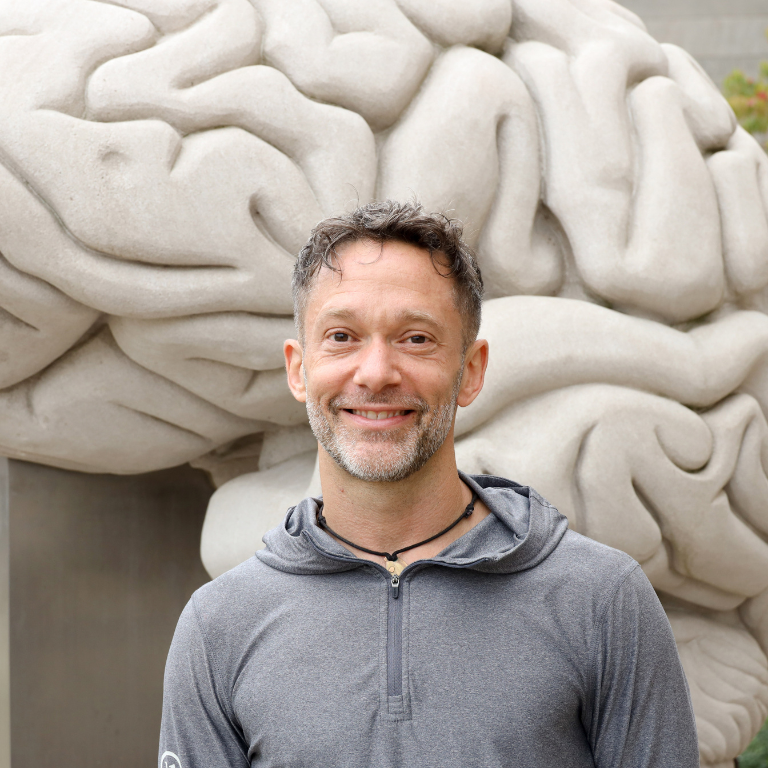
PBS Associate Professor Ehren Newman
From reward- to curiosity-driven learning
Moreover, as Newman deciphers the memory encoding process, he and his collaborator, IU Luddy School professor Goran Gordon, will pursue yet another intriguing line of inquiry that they hope will yield insights useful to the field of artificial intelligence: To better understand the “curiosity-driven learning” witnessed in their animal subjects, which often occurs alongside the traditional reinforcement- or reward-based learning long studied in psychology labs since the early 20th century. Reward-driven learning has provided the foundation for many forms of artificial intelligence. Yet, curiosity-driven learning, they believe, may also have much to offer as a model for AI. As Newman explains, “However advanced we’ve gotten in AI from reward- driven learning, it seems like curiosity-driven learning may also be extremely potent. It’s just underdeveloped as an approach to AI.” As he further explains, “Curiosity-driven learning is about seeking information rather than a reward, where information is formally defined as that which reduces uncertainty. So instead of choosing which action I should take to make it more likely I get a reward, it says which action will increase the probability I’ll learn something.” The rats they study might be a useful role model for how to balance curiosity-driven learning with reward-driven learning and provide a new template for AI learning.
A critical mass for mentorship
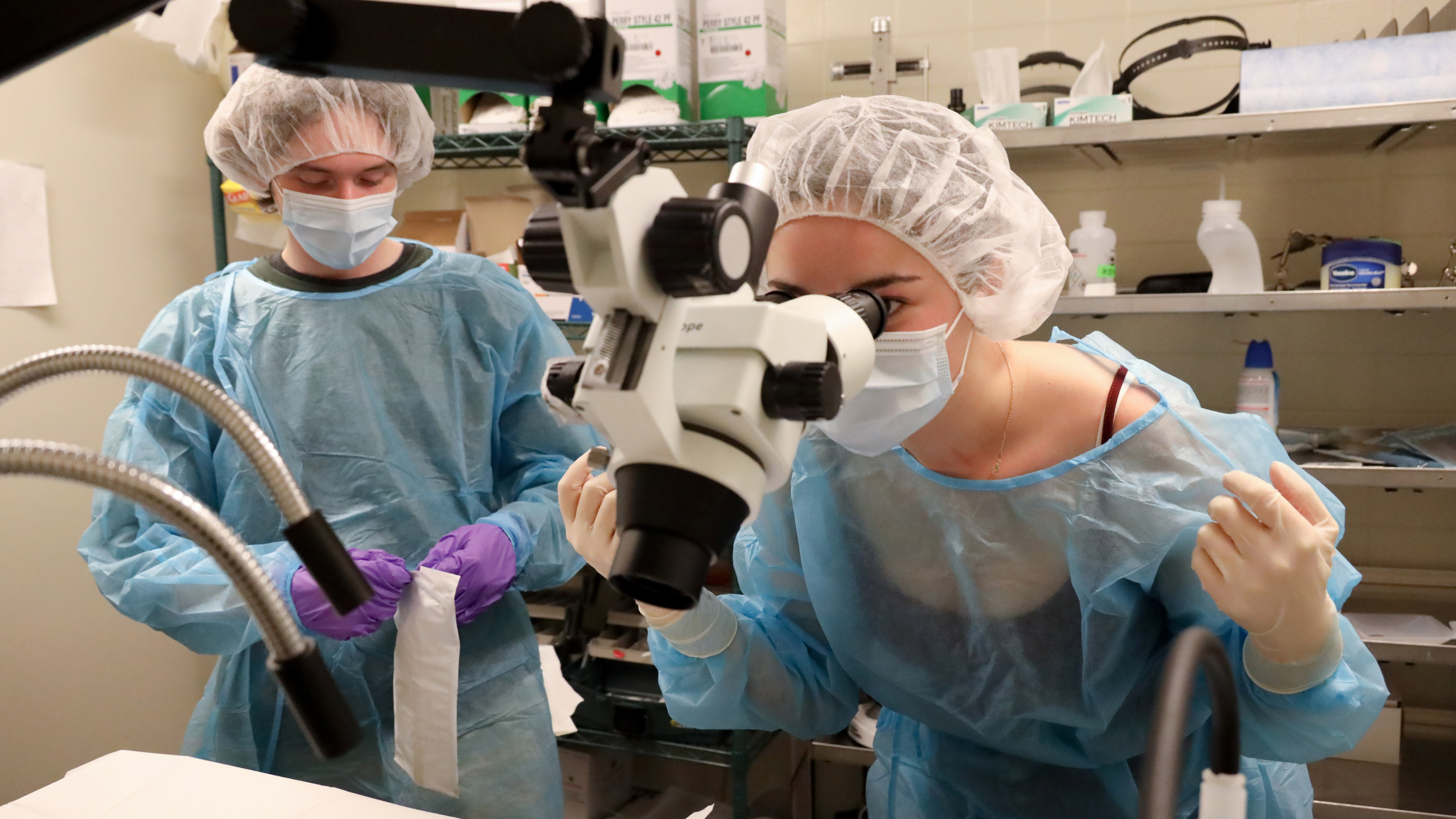
The lab itself is likewise a kind of template for student learning. Newman recalls his own experience as an undergraduate in a lab in which the undergraduates played a vital role. That model became his own. He now sees the ideal lab community as a group of about 10-12 students whose interactions make possible an especially effective kind of learning. “It’s a critical mass,” he says, “that enables the students to see themselves through the other students.” The younger students get to observe and learn from the older students, while the older students acquire a sense of confidence and expertise by teaching the younger students what they do. The students also have insights into the distinct kind of learning that takes place in the lab.
- As junior Sophia Sullivan explains, “Being in the classroom is a good foundation for learning the basics, but being in an actual lab is a totally different type of learning. It’s hands-on and you can ask questions. You can make mistakes and learn from them, challenge old ideas and come up with your own. You can take your own initiative; use the stuff you learn in the classroom and think about it in a different way.”
- Junior Sami Lawrence similarly relishes the learning opportunities in the lab: “So many specifics come up in the lab that don’t come up in the classroom. Our postdoc Ryan will say, ‘You learn about this in the classroom. Here’s what it looks like in the brain and this is what it does.’ Once you can see and visualize it, you realize it’s so cool. I have thought so many times, the way science works is so crazy.”
- Senior Dylan Burks discovered that research entails “picking up a lot of useful skills, doing experiments, and reading a lot of papers about what other people are doing in their labs,” adding that this reading is what “Dr. Newman does to get inspiration for his own experiments.”
- Junior Kendyl Bond remarks on how much she enjoys mentoring new members of the lab and at the same time has the opportunity “for more in-depth one-on-one time with Dr. Newman and the post-doctoral researcher.”
Technology and the unexpected
Other students describe the technological knowledge they have gained.
- Incoming first-year students Mariah Questelles and Nijah Monestime used the lab’s optogenetic techniques to conduct an experiment for display on a poster at an IU Groups poster session. Questelles explains, “We wanted to see how many times the rat rears when we inhibit it at different times. In the control study we see how much the rat rears without the laser inhibition.”
- Like Questelles, Monestime is fascinated by the work they do in the lab. “It is surprising and cool that we’re able to turn off the cells we want at any time with this technology.” They also learned how to “video score to record the rat’s behavior.” And when the resulting data was “the opposite of what we were expecting,” they learned that they would need “to come up with a story to explain why.”
- Luddy School sophomore Zasha Benites Mendez contributes her programming skills, using the Python programming language to help understand the rats’ behavior. “I just created a script,” she explains. “It takes the input of the animal moving through a certain amount of time and represents it in a single vector.”
As senior Sudharshini (“Sue”) Muthukarunakaran sees it, the lab demands a different kind of focus than the classroom. “In the classroom you learn enough to get a certain grade. But in the lab you can dig deeper,” she suggests. “You can do more things and are forced to read up on them to know what they mean.”
Above all, however, the greatest asset of the lab for her is the committed and upbeat attitude of all its members. And she seems to speak for all its members when she says, “The main thing I love about this lab is how much everyone cares about it.”
Students in the Newman Lab
Kendyl Bond is a junior from Fort Wayne majoring in neuroscience with plans to attend medical school. She has been in the lab for about a year and a half and was excited to take on a few more tasks this summer, one of which was “brain slicing.” She also trains new rats on the eight-arm maze and scores research videos of the rats to document their behaviors. “We’re comparing what happens in their brains during rearing and lateral head scanning (when the rats peer over the walls). We think these behaviors help them encode memories.”
A senior from Noblesville, Dylan Burks has been exploring the many branches of neuroscience before settling on the one he most wants to pursue in the future. He now plans to go to graduate school where he can “delve deeper into the biological aspects of neuroscience, into biological mechanisms and functions.” He highlights the value of his summer research: “Summer in the lab has been really nice. Last summer I had a full-time job where I felt like I wasn’t learning anything. This summer I’m learning a lot.”
Sami Lawrence is a junior Cox Research Scholar from Newburgh majoring in biology and animal behavior who plans to become a vet. In the lab she focuses on animal welfare and even conducts some of the surgery needed to set up their optogenetic technology. She wants to learn everything she can about animal welfare, seeing that animals are a necessary part of medical research. “I want to give back to the animals. They do so much for us,” she says. She is currently pursuing her own project on how sniffing, like rearing, might contribute to encoding spatial memory – a new topic for the lab “that everyone is very excited about,” she says.
Sophomore Zasha Benites Mendez from Lima, Peru, is a computer science major at the IU Luddy School of Informatics, Computing, and Engineering. Asked how she came to work in the lab? “It’s a funny story,” she says. “In Peru research isn’t talked about much because it’s not often funded. So when I applied for the opportunity, I did not really understand what it was.” Her initial interest in computer science grew out of the desire to create her own website. To do so, she taught herself how to use the Python programming language. Since coming to IU, she has become enthralled by the concept of neural networks. “I just find it so amazing,” she says. “Sometimes when you’re going through the code, you just get these ‘wow’ moments.”
Nijah Monestime is a first-year student from Noblesville, who participated in the lab during the summer as a STEM student in the Groups program. “When I entered high school,” she says, “I was mainly interested in the heart and in cardiology, but as time went on, I became more interested in how the brain functions, how it helps us do everything we are doing right now, such as having this conversation. Since then, I got more interested in the mental aspect of things. So I’m interested in psychiatry.” Currently, she is a pre-nursing student with a long-term goal of going into psychiatry.
Sudharshini Muthukarunakaran is a senior from Seattle, WA, majoring in neuroscience. Whether she decides to go to medical school or pursue a Ph.D. in neuroscience, she wants to be “part of a system figuring out how to stop the progression of Alzheimer’s,” she says. She has firsthand experience working with aging patients as an emergency medical technician in rural Indiana. In the lab, which she joined last January, she is engaged in its Alzheimer’s research, comparing the brainwaves of sleeping rats with and without Alzheimer’s Disease.
Mariah Questelles, a freshman from Indianapolis majoring in neuroscience, plans to go to medical school to become a neurosurgeon. She has wanted to be a doctor since she was a little girl, recalling how “I would put on the gloves and ask the doctor a million questions,” while visiting relatives in the hospital. She also loved the animated children’s television series, “Doc McStuffins,” which featured a six-yearold Black girl who practices medicine on her stuffed animals to be like her mother who is a doctor. “It was the first time I saw a black woman doctor and I could just see myself doing that,” she observes.
Sophia Sullivan is a junior from Carmel majoring in psychology while pursuing a neuroscience certificate. It has been a year since she joined the lab with the help of the Center of Excellence for Women in Technology which connects women students with research opportunities. “It’s really cool to see what’s hidden behind these walls,” she says about the Psychology Building, “like the MRI machine and all the research.” Her main focus in the lab this summer was to implant 16 tetrodes into the brain of each rat, in order to record how the cells fire in relation to what the rat is doing. “Neuroscience sounds so scary at first,” she reflects, “and now to be saying, ‘Oh, I work in a neuroscience lab,’ is amazing.”
LIZ ROSDEITCHER
Science Writer
 The College of Arts